Choose architecture by operational risk, reversibility, ownership and maintenance, then use the linked guides, which draw on documentation, fictional examples and specifications for tests that have not been run.
A stack decision becomes an operating commitment once customer data, scheduled jobs and billing depend on it.
Use these guides to compare code, visual builders, automation, Supabase and AI according to the failures you must prevent, the changes you may need to reverse and the system you can maintain.
Start with the failure you would have to own
A solo founder does not need the most flexible architecture in theory. The stack has to keep the product's specific promises while one person ships changes, answers support and handles incidents. List the failures that would harm a customer before comparing platforms: lost data, incorrect output, broken access, delayed automation, an unavailable dependency or a bill that rises faster than revenue.
Decision lens
Question to answer
What to favour
Operational risk
Which failure would be hardest to detect, explain or recover from?
Fewer hidden steps, observable jobs, recoverable data and clear failure states.
Reversibility
Can you change this choice without moving the whole product at once?
Exportable data, replaceable boundaries and small experiments outside the critical path.
Ownership
Who controls customer access, data, business logic and credentials?
An arrangement you can inspect, back up and transfer without relying on one personal account.
Maintenance
What recurring work arrives after launch?
A stack whose updates, logs, permissions and recovery tasks fit the time you can actually give them.
Separate the stable core from the replaceable edge
Customer records, permissions, billing state and the rules that produce the promised result usually deserve more care than an internal dashboard or an experimental automation. Keep the critical data path understandable. Put uncertain integrations behind boundaries you can retry, disable or replace. If an AI service contributes to an output, decide what happens when it is slow, expensive, unavailable or confidently wrong.
A fast build is only fast if you can still diagnose it after launch. Count support, monitoring, upgrades, backups and migration work as part of the architecture.
Choose the reading route by risk, not by tool name
Compare visual builders when the interface needs to change quickly without surrendering ownership of the data model or backend.
Use the n8n guidance for jobs that can be retried or reviewed, not as an automatic answer for every critical request.
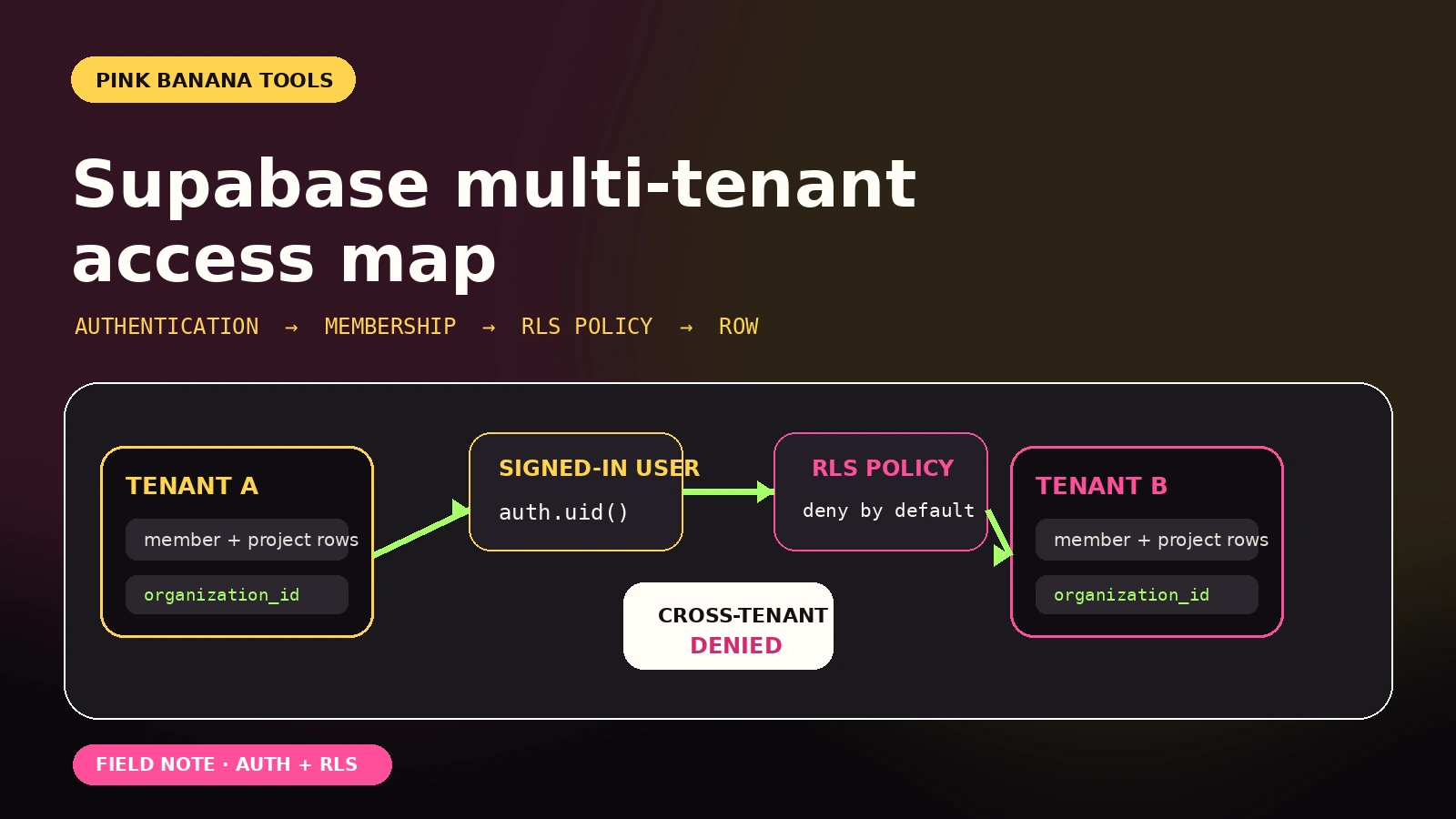
Read the Supabase material when authentication and customer data are central to the product's risk.
Open the AI cost and integration notes only after you can describe the model's job, fallback and spending boundary.
Before committing
Write down how you will export the data, recover a failed job, rotate credentials, inspect production behaviour and hand the system to another operator. A tool that cannot support those answers is creating a future project, not removing one.
Specify eleven Supabase tenant-access cases with fixture resets, grants, row-policy checks and a separate server-bypass control. Execution remains to be done.
Follow five fictional AI requests through repair, refusal and review. Separate hypothetical provider charges from labour and keep unreviewed output out of reminders.
Record the choice you can revisit
For the architecture under consideration, write a short record with five parts: the customer promise it protects, the main failure mode, the data owner, the exit path and the maintenance work you accept. Add the condition that would make you reconsider. This keeps a provisional choice provisional instead of turning tool familiarity into permanent infrastructure.