Word Unscrambler · observed 2026-08-17
Why a matching word disappears from your shortlist
Why does silent disappear from the English rack listen when listen stays? Follow the prefix filter, then try French accents and a missing letter to see what changes the shortlist.
Why silent disappears
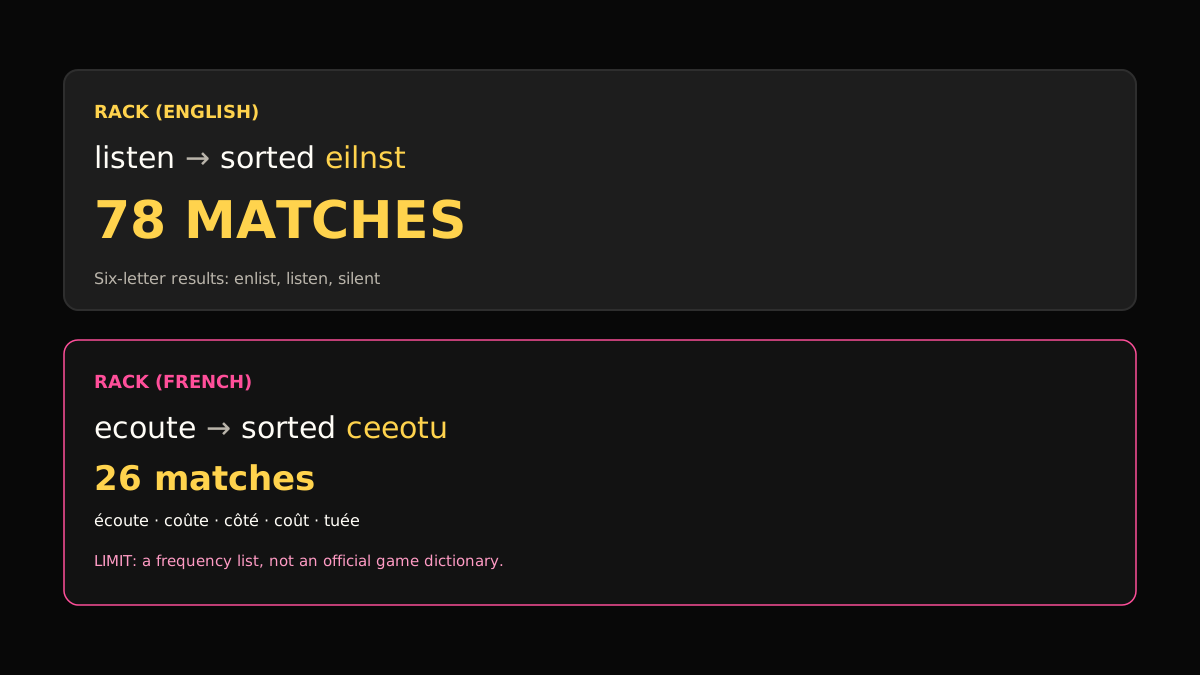
Select English, enter listen and leave the filters empty. On , the production interface showed the sorted rack eilnst and 78 candidates. Three used all six letters: enlist, listen and silent; the rest were shorter.
Keeping the rack and language unchanged, entering li in Starts with reduced the total to 10. In the six-letter group, only listen remained. silent still fits the rack and belongs to the English list; it fails the requested prefix.
There was no exact-length input. “6 letters” was a results heading, not a filter: read that group to find words using the whole rack.
English · listen → eilnst
78 → 10 matches
No filters: six-letter candidates
- enlist
- listen
- silent
Starts with: li; other filters empty. Six-letter candidate:
- listen
Observed 2026-09-13. Excluded by a prefix, not by a game rule.
An accent can fold; a missing letter cannot
With Français selected, ecoute returned 26 candidates and the sorted rack ceeotu. The only six-letter candidate was écoute. Shorter results included coûte, then côté, coût and tuée in the four-letter group.
The accented racks below look alike: NFC uses a composed é; NFD uses e plus a combining acute accent. Both returned the same 26 candidates as ecoute in these checks. Copy the rack itself to preserve the tested form.
Removing the second e to make ecout left 21 candidates. Accent folding cannot supply the missing letter: écoute needs two e’s after normalization; coûte needs only one and remained.
A separate English check with zzzz and empty filters returned no candidates. That is an empty shortlist for this rack and served list, not proof that no such word exists in any dictionary.
| Rack to copy | Starts with | Total | Longest group |
|---|---|---|---|
ecoute | Empty | 26 | 6: écoute |
écoute (NFC) | Empty | 26 | 6: écoute |
écoute (NFD) | Empty | 26 | 6: écoute |
ecoute | éc | 1 | 6: écoute |
ecout | Empty | 21 | 5: coûte |
Find the list behind the shortlist
The served English and French JSONs each contained 20,000 entries on 2026-09-13. The public word-list manifest records the source, changes and SHA-256 fingerprints. Both lists matched those fingerprints; the lists, manifest and tool script stayed unchanged across the observations.
The source is FrequencyWords by hermitdave, at commit 525f9b5, derived from OpenSubtitles2018 frequency data. It ranks words from subtitle text; it is not an official game dictionary.
The manifest declares selection of the first 20,000 unique frequency-ranked tokens with 2–18 normalized Latin-script letters, allowing internal apostrophes or hyphens. It lists Unicode normalization, deduplication and JSON serialization as adaptations. These are declared processing steps, not an independently reproduced build.
Two served lists
English candidate list (JSON)
French candidate list (JSON)
Content licence: CC BY-SA 4.0
FrequencyWords licenses its code under MIT and its content under Creative Commons Attribution-ShareAlike 4.0. Reusing the word data calls for attribution, a licence link and identification of changes; shared adaptations carry the same licence conditions.
Those source links identify the declared terms, not a blanket legal clearance for every use.
What these matches establish
The historical 2026-08-17 receipts recorded listen → eilnst with 78 matches and ecoute → ceeotu with 26. September’s separate observations agree on those counts, but cannot establish that every entry or behaviour stayed the same between dates.
The eight September cases used the production interface in Chromium 148.0.7778.96. An independent check compared every captured candidate with the served list, available letters after normalization, requested prefix and displayed length group. This checks the captured matches, not completeness across racks or languages.
A frequency list can include names, abbreviations and fragments. Even when a candidate fits your letters, consult your game’s dictionary and edition before playing it. Neither inclusion nor omission here settles admissibility.
Missing a candidate? Keep the language and rack fixed, clear the filters, then add the prefix you need. Compare the appropriate length group. If the word is still absent, check its letters and look for it in the linked language JSON.