Word Counter · observed 2026-08-17
Six counts the Word Counter actually returned
Did a paste change your text—or just expose a different counting rule? Compare hard returns, accents and character units before cutting words to meet a limit.
A word limit needs a counting rule
The same-looking accented text returned three words in composed Unicode and six in decomposed Unicode. A hard return changed a paragraph total without changing the word total. To use either count, you need to know which boundary the counter recognizes—and which one your assignment requires.
The cover shows an observation from 2026-08-17. The ten copyable inputs below were entered on 2026-09-13: six original cases, variants for line breaks and accents, and an emoji. The greeting with a real LF, NFC accents, two-sentence sample, triple hyphen and Chinese sample all matched their August totals. The URL record needs a correction, explained below.
To compare, use language mode auto and writing mode blog. The recorded run used Chromium 148.0.7778.96, UTC, en-US, in a fresh browser context. These are observed counts for those settings, not a linguistic standard.
Copy the text, not its description
Select only the contents of an input block. Blocks described as two lines contain a real line-feed character (LF), not a written backslash followed by n. A line that wraps on a narrow screen is not necessarily a stored line break.
The dashboard's “Characters” totals below match UTF-16 code units for these samples. “Without whitespace” reports the observed “No spaces” field; it excludes the tested spaces and hard line breaks.
1. A greeting with one hard return
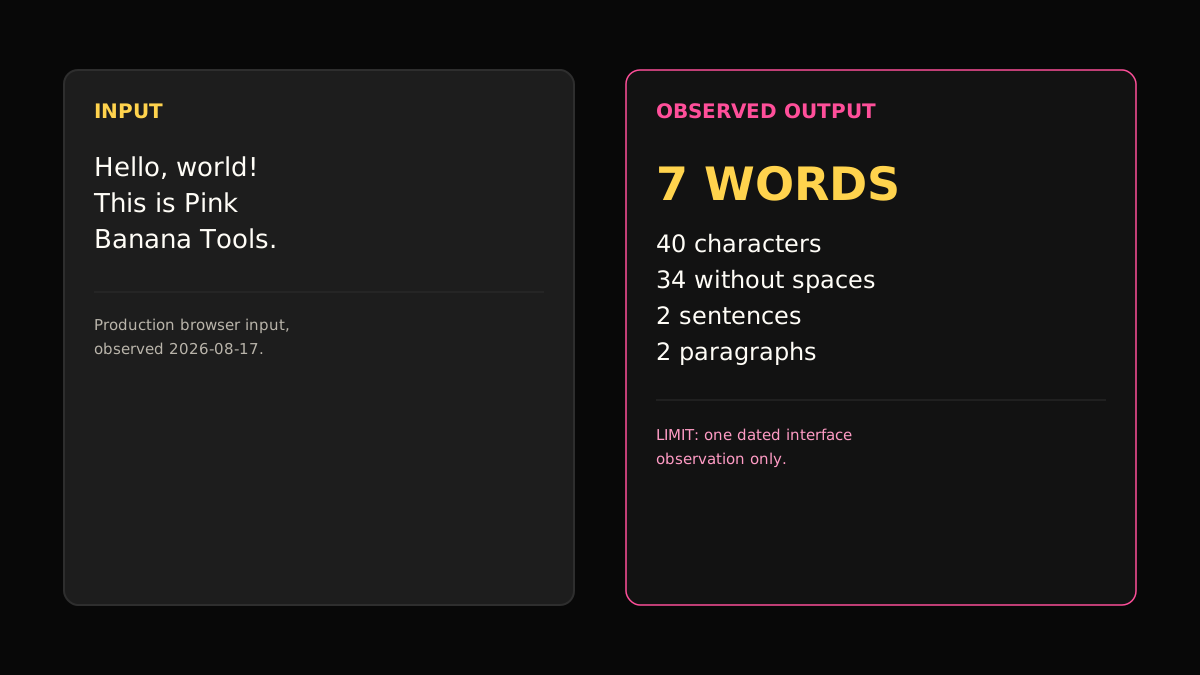
The first block contains a real line break; the second contains the literal characters \n. Both returned seven words and two sentences, but only the real LF produced two paragraphs.
The character totals differ too. A log may display a line break as an escape sequence, so compare the stored input rather than relying on how the log prints it.
Input: one real LF
Hello, world!
This is Pink Banana Tools.
Observed 2026-09-13
7 words
40 characters (UTF-16 units)
34 without whitespace
2 sentences
2 paragraphs
Variant: literal backslash + n; no LF
Hello, world!\nThis is Pink Banana Tools.
Observed 2026-09-13
7 words
41 characters (UTF-16 units)
36 without whitespace
2 sentences
1 paragraph
2. The URL case: one line or two?
The 2026-08-17 record reported 3 words, 42 characters, 39 without spaces, 2 sentences and 1 paragraph, but showed a hard return after mother-in-law while describing a single line. That pairing was inconsistent: its paragraph total cannot substantiate the two-line input.
The September variants isolate the difference: replace the space after mother-in-law with an LF and paragraphs rise from one to two. All other listed totals stay the same. The period here is inside the URL, not at the end of a sentence. Treat the sentence field as a heuristic, not a linguistic judgement.
Input: one line, with spaces
don't mother-in-law https://example.com 😀
Observed 2026-09-13
3 words
42 characters (UTF-16 units)
39 without whitespace
2 sentences
1 paragraph
Variant: one LF after mother-in-law
don't mother-in-law
https://example.com 😀
Observed 2026-09-13
3 words
42 characters (UTF-16 units)
39 without whitespace
2 sentences
2 paragraphs
3. The same-looking accents, different totals
NFC stores these accented letters as individual code points. NFD uses letters followed by combining marks for the diaeresis, acute accents and grave accent. The strings are canonically equivalent, yet NFD returned 6 words and 22 UTF-16 units, against NFC’s 3 and 18.
If apparently identical text gets a different count after a paste, compare its Unicode representation before deleting words. Keep the original: normalization changes the stored string. This pair exposes a normalization-sensitive count, not the behavior of every accented word or language.
Input: NFC (composed)
naïve café déjà-vu
Observed 2026-09-13
3 words
18 characters (UTF-16 units)
16 without whitespace
1 sentence
1 paragraph
Variant: NFD (decomposed)
naïve café déjà-vu
Observed 2026-09-13
6 words
22 characters (UTF-16 units)
20 without whitespace
1 sentence
1 paragraph
4. Two paragraphs without a blank line
A single LF separates these sentences; there is no empty line. The counter nevertheless reports two paragraphs. If your assignment defines a paragraph break as a blank line, this total uses a different boundary. Changing the layout just to make the numbers agree would hide that difference.
Input: one LF, no blank line
One sentence.
Second line?
Observed 2026-09-13
4 words
26 characters (UTF-16 units)
23 without whitespace
2 sentences
2 paragraphs
5. Two words without a space
hello---world has no spaces but returned two words. Counting only space-separated groups would miss this split. Preserve all three hyphens when comparing counters; this result does not tell you how every hyphenated construction is handled.
Input: three consecutive hyphens
hello---world
Observed 2026-09-13
2 words
13 characters (UTF-16 units)
13 without whitespace
1 sentence
1 paragraph
6. One displayed word is not Chinese segmentation
The entire unspaced sample returned one word. That total does not identify linguistic boundaries inside the text. For a Chinese word limit, use the required segmentation method; for a character limit, first establish the character unit. Neither requirement is answered by calling this string one word.
Input: continuous Chinese text
中文没有空格
Observed 2026-09-13
1 word
6 characters (UTF-16 units)
6 without whitespace
1 sentence
1 paragraph
An emoji makes the character unit visible
The additional September input, 😀, is one Unicode code point stored as two UTF-16 code units. The interface’s 2 characters reflects the latter. A code-point counter would be measuring a different unit.
Neither code points nor UTF-16 units always correspond to the characters a reader perceives. For a character limit, use the destination’s stated unit—or check the exact text there.
Additional input: one emoji
😀
Observed 2026-09-13
0 words
2 characters (UTF-16 units)
2 without whitespace
1 sentence
1 paragraph
Keep the troublesome span of your draft alongside its count, language mode and writing mode. If another editor disagrees, that small sample lets you compare the counting rules without rewriting the whole draft.
Read time, speak time and draft-check values were not validated against real readers: they are estimates or heuristics, not measured reading speed, quality grades or SEO evidence. Empty input was not tested.