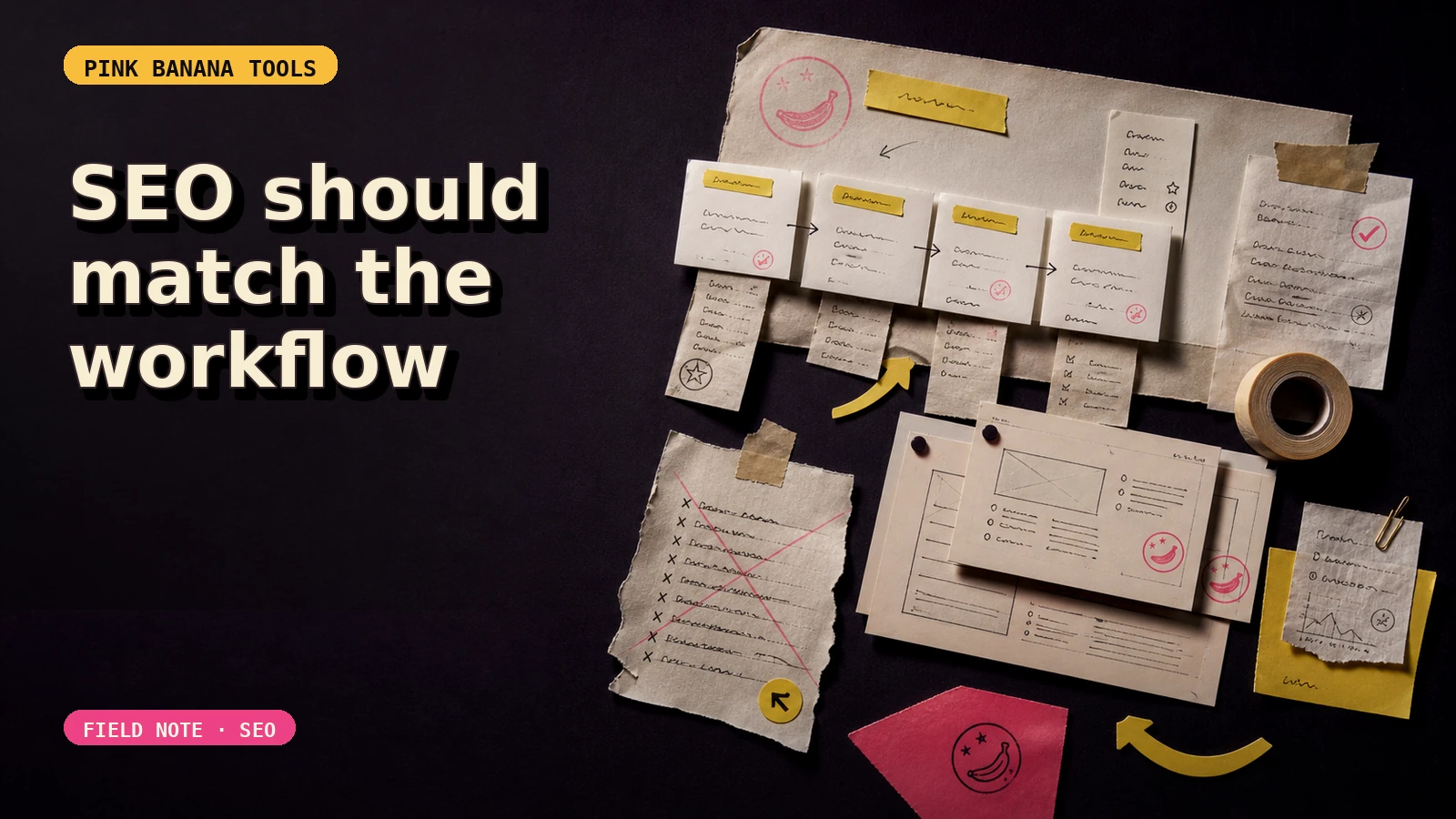
A support message asks whether reminder history can be exported. Someone copies the wording into a keyword sheet, adds three close variants, and schedules three articles. Stop before the URLs exist.
Gate the question before you search it
Keep the original wording, source, date, and account context only in a system you are authorised to use. Remove names, account identifiers, private configuration, negotiated terms, and any combination of details that could identify a person or business. If the useful meaning disappears when those details are removed, the answer may need to remain private.
One question proves that one uncertainty existed. It does not establish search demand, market size, or a content opportunity. Treat it as an observation that can enter a decision process—not as a keyword with a forecast attached.
Use search results as dated context, not permission
Run an inspection in the language and market you intend to serve. Record the date, query variants, location or localisation, and any personalisation constraints. Note the jobs visible in the results: troubleshooting, product documentation, comparison, education, template use, or a direct tool action.
The result page can show what is visible at that moment. It cannot prove that your site should own the topic, that a new page will rank, or that traffic will follow. Make the decision from the reader’s job, your product’s ability to support the answer, and the overlap with pages you already have.
Google Search documentation observed on 2026-07-28 recommends useful, reliable, people-first content and using words readers employ in prominent locations. Its spam policies describe doorway abuse as creating sites or pages to rank for specific, similar queries and leading users to intermediate pages that are less useful than the final destination. Overlap alone does not establish those conditions. Those guidelines support a restraint: do not multiply near-duplicate pages to capture wording variants. They do not supply a ranking formula.
Five destinations, including nowhere
- Create: a new URL has a distinct reader moment, a complete answer, authorised evidence, and a job not owned elsewhere.
- Improve: an existing page already owns the decision but lacks a step, edge case, limitation, or example.
- Document: the answer depends on current controls, permissions, field meanings, setup steps, or recovery behaviour.
- Private: the answer depends on confidential context or a negotiated account commitment.
- Reject: the product cannot support the promise, the evidence cannot be used, the intent is unrelated, or the proposed answer would be thin.
Give every full answer one owner
Compare the proposed answer with the current inventory side by side. Ignore wording and ask harder questions: Is the same person in the same situation? Are they trying to make the same decision? Would both pages need the same procedure and evidence? Would they lead to the same next action?
If those answers converge, improve the stronger page. If the question is “How do I export the reminder-change log?” the owner is probably documentation. A separate article might own “What should an audit export contain before a handover?” only if that is genuinely a different decision with different evidence—not a long introduction to the same export steps.
Local HTML observation — 15 September 2026. Comparing these two files supports the following editorial division of work; this is not a search-results inspection, traffic or ranking test, or live before-and-after comparison.
| Page and observed headings | Editorial owner |
|---|---|
| /validation.html H1: “Validate a micro-SaaS idea before building”. Sections: “Build an evidence ladder” and “Choose the next article from the evidence you lack”. | The hub’s role is to help readers choose which unknown to investigate and find the relevant next step. |
| /articles/micro-saas-idea-validation-without-building.html H1: “Validate a micro-SaaS idea with a pre-build decision dossier”. Sections: “Begin with the claim that could kill the idea” and “Keep observation, interpretation, and action apart”. | The article’s role is to help readers produce the pre-build decision dossier: a testable claim, a bounded test and a record separating observation from interpretation and action. |
The observed hub asks readers to follow an evidence ladder before seeking commitment. Replacing that fixed hierarchy with a choice based on the unknown is a local editorial proposal in progress, not a published result. Keep the dossier procedure with the article; the hub needs enough context to help readers choose it.
Google’s link guidance says crawlable links and descriptive, contextual anchor text help readers and Google understand the destination. Use the anchor to name the next decision. Do not build a ring of “learn more” links around pages with indistinguishable jobs.
A hypothetical question, with no fictional search inspection
Illustrative question only; not a customer quote, live query, or observed result. “Can a workspace owner export a dated log of reminder-schedule changes?”
Before deciding, the founder would need to inspect the current product and documentation, run and save a real dated search and site inventory, and answer:
- Does the capability exist, and which roles may use it?
- Can the export’s fields, limits, and retention behaviour be supported?
- Does an existing documentation page own the procedure?
- Would a public answer expose private implementation or account details?
- What product or source change would make the answer stale?
Without those checks, there is no invented “current SERP” and no assumed content opportunity. The provisional decision is hold. After inspection, the final decision may be document, improve, private, or reject. A new article is only one possible outcome.
Keep a short page decision record
| Field | What to write |
|---|---|
| Question boundary | Privacy-safe wording, authorised source type, reader moment, and what was removed. |
| Dated context | Queries, market, language, date, visible jobs and formats, with no traffic inference. |
| Product support | Capability check, evidence available, important limits, and owner. |
| Corpus overlap | Nearest URLs, same/different job, and the reason one page should own the answer. |
| Disposition | Create, improve, document, private, or reject—with one sentence of reasoning. |
| Reinspection trigger | A changed workflow, permission, price, source, screenshot, recurring second job, or emerging overlap. |
Volume estimates, content calendars and clusters come later. Otherwise you are optimising production before deciding whether anything deserves to be produced.
The no-page test
A disciplined backlog is not merely short. Every question has an owner, and “no page” remains a legitimate state. Take one privacy-safe question and force one disposition. If you cannot name the supported answer, page owner and reinspection trigger, do not create the URL.